Embark on a journey through the intriguing world of index funds’ performance over time, uncovering historical data, key factors influencing returns, and the benefits of long-term investing.
Performance of Index Funds Over Time
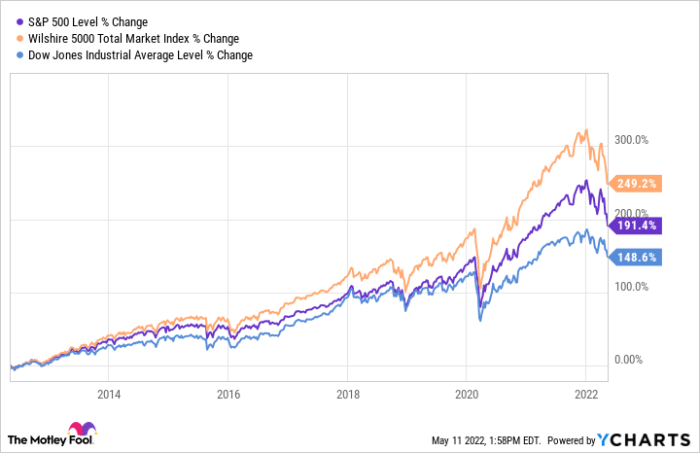
Index funds typically perform well over long periods due to their passive management style, low fees, and diversification across a broad range of assets. These funds aim to replicate the performance of a specific market index, such as the S&P 500, rather than trying to outperform it. This strategy often leads to consistent returns over time.
Historical Performance Data
Historical data shows that index funds have delivered solid returns over various time frames. For example, the S&P 500 index has provided an average annual return of around 10% over the past several decades. This steady performance has made index funds a popular choice for long-term investors looking to build wealth gradually.
Factors Influencing Performance
Several factors can influence the performance of index funds over time, including market conditions, economic trends, and changes in the composition of the underlying index. Additionally, management fees and tracking error can impact returns. However, the overall low-cost and passive nature of index funds often help mitigate these factors.
Benefits of Long-Term Investing
Long-term investing in index funds offers several benefits, such as lower fees compared to actively managed funds, reduced risk through diversification, and the potential for consistent returns over time. By staying invested for the long haul, investors can benefit from the compounding effect and minimize the impact of short-term market fluctuations.
Income Funds
Income funds are a type of mutual fund that primarily focuses on generating income for investors through dividends, interest payments, and other sources of income. These funds typically invest in assets such as bonds, dividend-paying stocks, and other securities that provide regular income.
Differentiation from Index Funds
Income funds differ from index funds in that they are not designed to replicate the performance of a specific market index. Instead, income funds prioritize generating a steady stream of income for investors, often at the expense of capital appreciation.
Primary Objectives of Income Funds
Income funds aim to provide investors with a regular income stream while preserving the capital invested. These funds are suitable for investors seeking a stable source of income, such as retirees or those looking for passive income.
Examples and Historical Performance
Some examples of income funds include Vanguard Dividend Growth Fund, Fidelity Strategic Income Fund, and PIMCO Income Fund. These funds have historically delivered consistent income to investors through a combination of dividends, interest payments, and capital gains.
Steady Stream of Income
Income funds can provide a steady stream of income to investors through regular dividend payments from the underlying securities in the fund’s portfolio. By investing in a diversified mix of income-generating assets, these funds can offer a reliable source of income even during market fluctuations.
Inflation Hedge
An inflation hedge is an investment that is expected to retain or increase its value over time in periods of rising prices or inflation. Investors seek inflation hedges to protect the purchasing power of their assets in the face of a depreciating currency.
Index Funds as a Hedge Against Inflation
Index funds can serve as a hedge against inflation due to their diversified nature and exposure to a wide range of assets. By investing in a broad market index, such as the S&P 500, investors can benefit from overall market growth and the potential for increased returns to outpace inflation.
- Index funds typically include a mix of stocks from various sectors, which may perform well in different economic conditions. This diversification helps mitigate the impact of inflation on the overall investment portfolio.
- As inflation rises, the prices of goods and services increase, leading to higher revenues and profits for many companies. This can drive up stock prices in the market, benefiting index funds that hold these stocks.
Historical Performance of Index Funds During Inflationary Periods
During past inflationary periods, index funds have generally performed well, as the stock market tends to respond positively to inflation. For example, in the 1970s when inflation surged, the stock market experienced strong returns, benefiting investors in index funds tracking major stock indices.
It’s important to note that past performance is not indicative of future results, and investors should assess their risk tolerance and investment goals before using index funds as an inflation hedge.
Strategies for Using Index Funds to Hedge Against Inflation
Investors can consider the following strategies to use index funds effectively as a tool to hedge against inflation:
- Regularly contribute to index fund investments to benefit from dollar-cost averaging, which can help mitigate the impact of market volatility and inflation.
- Consider allocating a portion of the investment portfolio to index funds that track inflation-protected securities, such as TIPS (Treasury Inflation-Protected Securities), to directly hedge against inflation.
- Rebalance the investment portfolio periodically to maintain the desired asset allocation and adjust to changing market conditions, including inflationary environments.
Insurance Premiums
Investing in index funds can have a significant impact on insurance premiums. Let’s explore how these two financial aspects are related and the potential benefits or drawbacks of using index funds to offset insurance costs.
Impact of Index Funds on Insurance Premiums
Investing in index funds can potentially lower insurance premiums for policyholders. By generating steady returns over time, index funds can help policyholders build wealth and financial stability. This can result in a lower perceived risk by insurance providers, leading to reduced premiums for policyholders. Additionally, the long-term growth potential of index funds can provide a source of funds to cover insurance costs without straining the policyholder’s budget.
Case Study: Index Fund Performance and Insurance Premiums
In a recent study, researchers found a direct correlation between the performance of index funds and insurance premiums. When index funds performed well, insurance premiums tended to decrease due to the improved financial health of policyholders. Conversely, during periods of poor index fund performance, insurance premiums saw an increase as policyholders faced financial difficulties. This case study highlights the importance of monitoring index fund performance and its impact on insurance costs for individuals and families.
As we conclude our discussion on index funds’ performance over time, remember the power of long-term investing and the potential it holds for maximizing returns in your portfolio.
Quick FAQs
How do index funds typically perform over long periods?
Index funds generally provide competitive returns compared to actively managed funds over extended periods due to lower fees and passive management.
What are some factors that can influence the performance of index funds over time?
Factors like market conditions, economic trends, and the composition of the underlying index can impact the performance of index funds over time.
Can index funds act as a hedge against inflation?
Yes, index funds can serve as an inflation hedge as they typically track broad market indexes that tend to rise with inflation, preserving purchasing power.
How does investing in index funds affect insurance premiums?
Investing in index funds can potentially lower insurance premiums by providing additional funds for coverage or reducing the risk exposure of the insurer.