Embark on a journey into the realm of ETF Income Funds, where strategic investments pave the way for maximizing returns. This overview sets the stage for exploring the intricacies of generating income through innovative financial instruments.
Delve deeper into the world of ETF Income Funds to uncover the strategies and benefits that shape the landscape of modern investment opportunities.
ETF Income Funds Overview
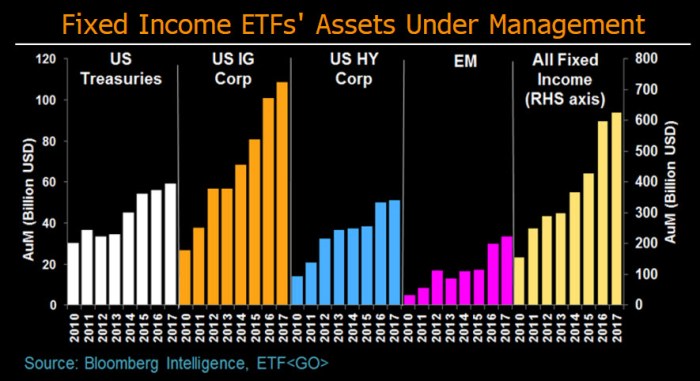
ETF income funds are investment funds that focus on generating income for investors through a portfolio of income-generating assets such as dividend-paying stocks, bonds, and other fixed-income securities.
How ETF Income Funds Generate Income
ETF income funds generate income for investors through various means, including:
- Dividend Payments: Many ETF income funds hold dividend-paying stocks that provide regular income in the form of dividends.
- Interest Payments: Some ETF income funds invest in bonds and other fixed-income securities that pay interest periodically.
- Capital Gains: ETF income funds may also generate income through capital appreciation when the value of the underlying assets increases.
Comparison with Traditional Income Funds
ETF income funds differ from traditional income funds in several ways:
- Trading Flexibility: ETF income funds trade on stock exchanges like individual stocks, allowing investors to buy and sell throughout the trading day. Traditional income funds are priced at the end of the trading day.
- Cost Efficiency: ETF income funds typically have lower expense ratios compared to traditional income funds, making them a cost-effective option for investors.
- Transparency: ETF income funds disclose their holdings on a daily basis, providing investors with greater transparency compared to traditional income funds that may only disclose holdings periodically.
Income Funds vs. Index Funds
When it comes to investing, it’s important to understand the differences between income funds and index funds. Income funds are designed to provide investors with regular income through dividends and interest payments, while index funds aim to replicate the performance of a specific market index.
Income Funds Focus on Generating Regular Income
Income funds are actively managed investment funds that focus on generating income for investors. These funds typically invest in dividend-paying stocks, bonds, and other income-generating securities. The primary goal of income funds is to provide a steady stream of income to investors, making them a popular choice for retirees or those seeking regular cash flow.
- Income funds may invest in a diversified portfolio of securities to maximize income while managing risk.
- Investors can choose income funds based on their risk tolerance and income goals.
- Income funds may have higher expense ratios compared to index funds due to active management.
Investment Objectives of Index Funds Compared to Income Funds
On the other hand, index funds are passively managed funds that aim to replicate the performance of a specific market index, such as the S&P 500. The investment objective of index funds is to closely track the returns of the underlying index, rather than actively selecting securities to outperform the market.
- Index funds typically have lower expense ratios compared to actively managed income funds.
- Investors in index funds benefit from diversification and low costs, making them a popular choice for long-term investors.
- Index funds are ideal for investors seeking broad market exposure and a simple, low-maintenance investment strategy.
Inflation Hedge in ETF Income Funds
Using ETF income funds as an inflation hedge involves investing in a diversified portfolio of income-generating assets, such as dividend-paying stocks and bonds, that have the potential to provide returns that outpace inflation over time.ETF income funds can help investors preserve purchasing power in inflationary environments by offering a combination of income generation and potential capital appreciation. When inflation erodes the value of currency, the income generated from these funds can help offset the loss in purchasing power by providing a steady stream of cash flow.
Role of Dividend-Paying Stocks
Dividend-paying stocks play a crucial role in providing an inflation hedge within ETF income funds. These stocks have the potential to increase their dividend payouts over time, which can help investors maintain or even increase their income in line with inflation.
Insurance Premiums and ETF Income Funds
When it comes to insurance premiums, ETF income funds can play a significant role in providing a source of income that can potentially help offset these costs. By investing in ETF income funds, individuals can generate regular income through dividends and interest payments, which can be used to cover insurance premiums and other expenses.
Using ETF Income Funds to Offset Insurance Premiums
- One strategy for using ETF income funds to offset insurance premiums is to focus on high-yield ETFs that offer a steady stream of income. These funds typically invest in dividend-paying stocks or bonds, providing investors with regular payouts that can be used to cover insurance costs.
- Another approach is to diversify investments across different types of ETF income funds to minimize risk and ensure a consistent income stream. By spreading investments across various sectors and asset classes, investors can potentially offset fluctuations in the market and maintain a steady source of income to cover insurance premiums.
- Investors can also consider reinvesting dividends and interest payments from ETF income funds back into the funds to compound returns over time. This can help grow the investment portfolio and generate additional income that can be used to cover rising insurance costs in the future.
Risk-Return Profile of Investing in ETF Income Funds
- While ETF income funds can provide a reliable source of income to potentially cover insurance premiums, it’s essential to consider the risk-return profile of these investments. These funds typically offer a balance between generating income and preserving capital, making them suitable for investors looking for steady returns.
- Investing in ETF income funds can provide diversification benefits and liquidity, allowing investors to access their funds when needed to cover insurance premiums or other financial obligations. However, like any investment, ETF income funds come with risks, including market fluctuations and interest rate changes that can impact returns.
- It’s crucial for investors to assess their risk tolerance and investment goals before allocating funds to ETF income funds to cover insurance costs. By understanding the potential risks and rewards associated with these investments, individuals can make informed decisions to help meet their financial needs and secure their insurance coverage.
As we conclude our discussion on ETF Income Funds, it becomes evident that the potential for growth and stability lies within the realm of strategic investments. Explore the possibilities and seize the opportunities that ETF Income Funds offer in the dynamic financial market.
Key Questions Answered
How do ETF income funds differ from traditional income funds?
ETF income funds offer the advantage of trading on exchanges like stocks, providing increased liquidity compared to traditional income funds.
Can ETF income funds serve as an effective inflation hedge?
Yes, ETF income funds can act as an inflation hedge by investing in dividend-paying stocks that have the potential to preserve purchasing power in inflationary environments.
What role do insurance premiums play in relation to ETF income funds?
Insurance premiums can be offset using strategies involving ETF income funds, depending on the risk-return profile of the investment.