Delving into the realm of investment strategies, the comparison between Growth and Value Index Funds offers valuable insights into navigating the complex world of finance. As we explore the nuances of these funds, a clearer picture emerges of the risks and rewards associated with each approach.
From understanding the foundational concepts to analyzing historical performance, this discussion aims to equip readers with the knowledge needed to make informed investment decisions.
Growth vs Value Index Funds
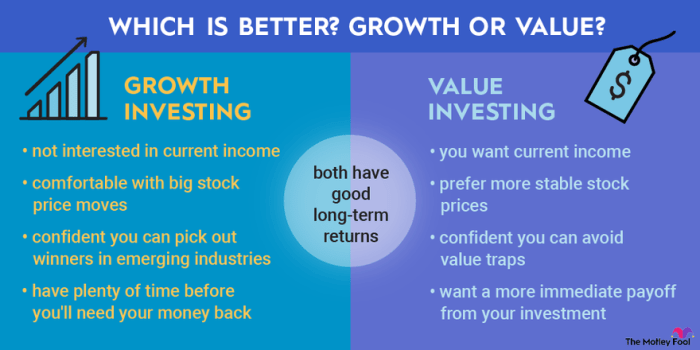
When it comes to investing in index funds, two primary categories that investors often consider are growth index funds and value index funds. These funds are designed to track specific indices and provide investors with exposure to different types of stocks based on their investment strategies.
Concept of Growth Index Funds
Growth index funds focus on investing in companies that are expected to experience rapid growth in terms of revenue and earnings. These companies are typically in industries that are considered to have high growth potential, such as technology or healthcare. Growth index funds aim to provide investors with capital appreciation by investing in these high-growth companies.
Definition of Value Index Funds
On the other hand, value index funds invest in companies that are considered to be undervalued by the market. These companies may have strong fundamentals but for some reason, their stock prices are trading below their intrinsic value. Value index funds focus on buying these undervalued stocks with the expectation that their prices will eventually rise to reflect their true worth.
Historical Performance of Growth and Value Index Funds
Over the years, growth index funds have generally outperformed value index funds during bull markets, when the stock market is rising. This is because high-growth companies tend to attract investors looking for significant returns. However, during bear markets or periods of economic downturn, value index funds have shown resilience and tend to perform better as investors flock to safer, undervalued stocks.
Risk Levels Associated with Growth and Value Index Funds
Growth index funds are typically considered to be riskier than value index funds due to their focus on high-growth companies, which are more susceptible to market volatility. On the other hand, value index funds are considered to be more conservative as they invest in undervalued stocks which may offer more stability during turbulent market conditions. Investors need to consider their risk tolerance and investment goals when choosing between growth and value index funds.
Income Funds
Income funds are a type of mutual fund or exchange-traded fund (ETF) that primarily focuses on generating consistent income for investors. These funds are designed to provide regular income payments through dividends, interest payments, or both, making them ideal for investors seeking steady cash flow.
Types of Securities in Income Funds
Income funds typically invest in a variety of fixed-income securities such as bonds, treasury bills, corporate bonds, and preferred stocks. These securities are known for their relatively lower risk compared to equities, making them suitable for income-focused investment strategies.
- Bonds: Income funds often hold a significant portion of their portfolio in bonds issued by governments or corporations, providing a steady stream of interest income.
- Treasury Bills: These short-term government securities are another common component of income funds, offering low-risk income opportunities.
- Preferred Stocks: Some income funds may also include preferred stocks, which pay fixed dividends and rank higher than common stocks in terms of priority for dividend payments.
Role of Income Funds in a Diversified Portfolio
Income funds play a crucial role in a diversified investment portfolio by providing stability and income during market fluctuations. By including income funds alongside growth or value investments, investors can balance risk and return while ensuring a consistent income stream.
- Diversification: Income funds help diversify a portfolio by adding fixed-income securities that can offset the volatility of equity investments.
- Income Generation: These funds are essential for investors looking to generate regular income without relying solely on capital appreciation.
- Risk Management: Income funds offer a more conservative investment option, reducing overall portfolio risk and providing stability during market downturns.
Top-Performing Income Funds
Some examples of top-performing income funds in the market include Vanguard High Dividend Yield Index Fund, Fidelity Strategic Income Fund, and PIMCO Income Fund. These funds have a track record of delivering consistent income and capital preservation, making them attractive options for income-seeking investors.
Inflation Hedge
In the world of investing, an inflation hedge refers to an investment that can protect the investor’s purchasing power from the effects of inflation. As the value of money decreases over time due to inflation, having investments that can outpace or at least keep up with inflation is crucial for maintaining the real value of one’s wealth.When it comes to growth and value index funds, they can serve as effective inflation hedges due to their potential for long-term capital appreciation.
Growth index funds typically consist of companies with high growth potential, which can lead to increased earnings and stock prices that outpace inflation. On the other hand, value index funds include stocks that are considered undervalued by the market, offering the potential for price appreciation that can also act as a hedge against inflation.Aside from growth and value index funds, other investment options can also serve as effective inflation hedges.
These include Treasury Inflation-Protected Securities (TIPS), real estate investments, commodities like gold and silver, and inflation-indexed annuities. Diversifying a portfolio with a mix of these assets can help mitigate the impact of inflation on overall investment returns.Considering inflation hedging in long-term investment strategies is essential for preserving the purchasing power of investments over time. By incorporating assets that have historically shown resilience against inflation, investors can better prepare their portfolios to withstand the erosive effects of rising prices and maintain their wealth in real terms.
Insurance Premiums
Insurance premiums are the amount of money an individual or business pays to an insurance company in exchange for coverage against specified risks. The cost of insurance premiums can be influenced by various factors, including the type of coverage, the insured party’s risk profile, and external market conditions. Investment choices, such as opting for growth or value index funds, can also impact insurance premiums.
Impact of Growth and Value Index Funds
Investing in growth or value index funds can affect insurance premiums in different ways. Growth funds typically have higher potential returns but also come with higher volatility, which may be perceived as a higher risk by insurers. On the other hand, value funds tend to be more stable but offer lower growth potential. Insurers may consider these factors when calculating premiums, leading to potential differences in costs based on the type of index funds in an individual’s investment portfolio.
- Growth index funds may lead to higher insurance premiums due to perceived risk.
- Value index funds could result in lower insurance premiums but with potentially lower investment returns.
Strategies to Manage Insurance Costs
To manage insurance costs while investing in index funds, individuals can consider the following strategies:
- Diversifying the investment portfolio to balance risk and potential returns.
- Regularly reviewing and adjusting insurance coverage based on changing investment strategies.
- Exploring options for bundling insurance policies to potentially receive discounts.
- Seeking advice from financial professionals to optimize both investment and insurance decisions.
Recommendations for Balancing Returns and Premiums
Balancing investment returns with insurance premiums is crucial for maintaining financial stability. It is essential to:
- Assess risk tolerance and financial goals to align investment choices with insurance needs.
- Regularly monitor and adjust investment and insurance strategies to adapt to changing circumstances.
- Consider the long-term impact of investment decisions on insurance costs to make informed choices.
In conclusion, the dynamic interplay between Growth and Value Index Funds underscores the importance of strategic diversification and risk management in building a robust investment portfolio. By carefully considering the factors discussed, investors can optimize their financial growth potential while mitigating potential downsides.
FAQ Overview
What are the key differences between Growth and Value Index Funds?
Growth index funds focus on companies with high growth potential, while value index funds target undervalued companies with solid fundamentals.
How do Growth and Value Index Funds perform historically?
Historically, growth index funds have shown higher volatility but potentially higher returns, while value index funds have offered more stability with moderate returns.
Can Growth and Value Index Funds act as inflation hedges?
Both types of index funds can potentially serve as inflation hedges, depending on the economic environment and market conditions.